When evaluating solar panels, system specifiers, installers, and property owners usually look at nameplate wattage ratings. A 650W panel sounds superior to a 620W panel on paper. Field data collected in the Philippines shows a different picture. Under actual tropical conditions, lower-rated premium modules consistently outproduce higher-rated back contact panels.
Understanding why this happens requires looking at semiconductor physics, standard testing limits, and real-world field benchmarks across panel technologies.
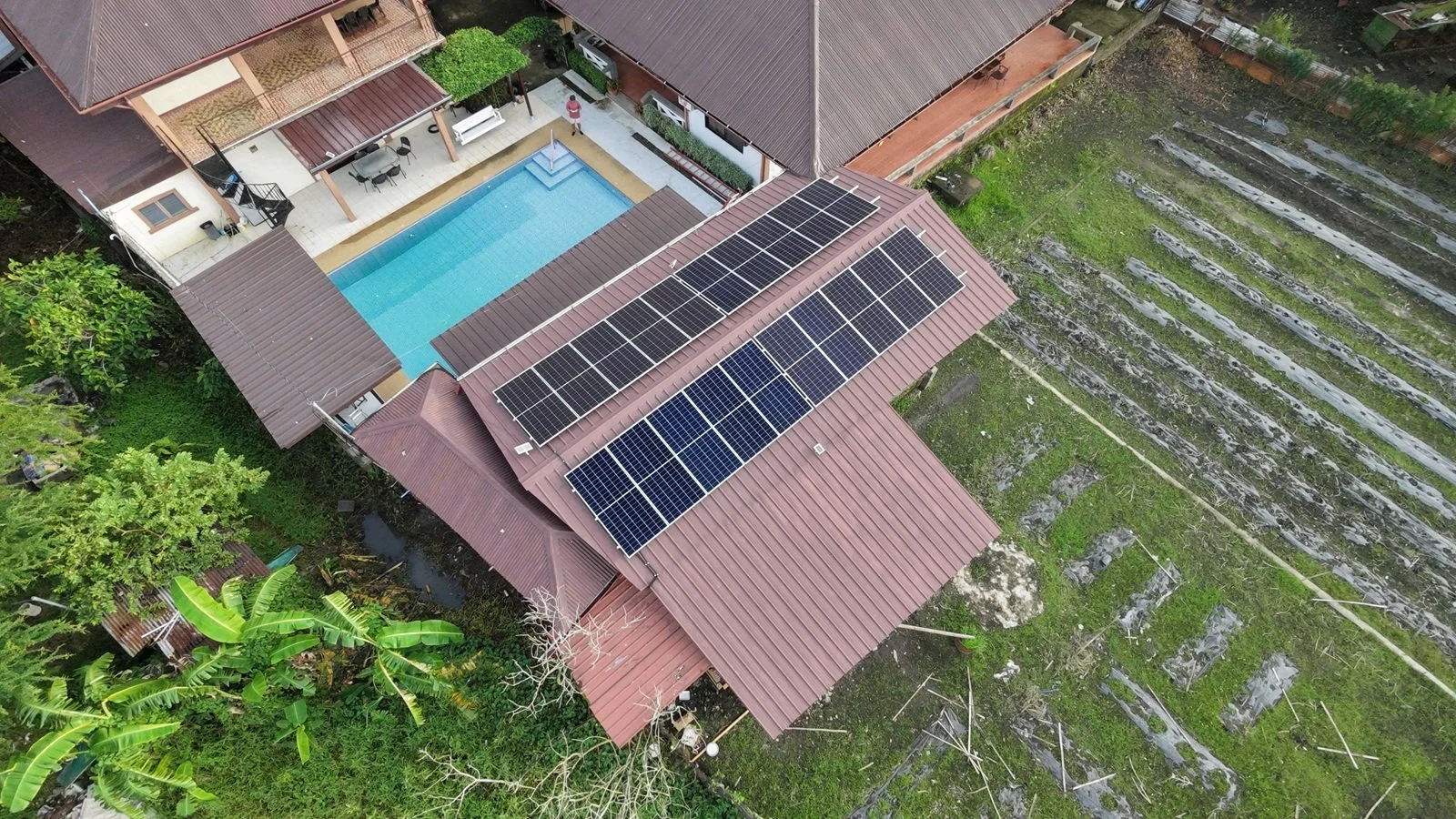
EcoSolutions installation featuring Back Contact (BC) panels and Panasonic TopCon panels featuring advanced heterjunction panel technology. Installation is located in provincial Laguna.
-
EcoSolutions distributes AIKO, LONGi, and Panasonic solar panels. This article shares field observations and technical comparisons to help buyers and installers evaluate real-world trade-offs.
The Standard Test Condition (STC) Illusion
Solar panels get rated globally under Standard Test Conditions (STC):
Irradiance: 1,000 W/m²
Cell Temperature: 25°C (77°F)
Air Mass: 1.5 Spectrum
A 25°C cell temperature is easy to keep in a lab, yet it rarely matches field conditions in the Philippines. In tropical climates, ambient air temperatures often reach 32°C to 38°C. Dark silicon cells absorb intense sunlight and run 20°C to 30°C hotter than ambient air. Rooftop cell temperatures easily reach 50°C to 65°C during peak sun hours.
Semiconductor Physics & Temperature Coefficients
Photovoltaic (PV) cells are semiconductors. Like other semiconductor devices, their electrical behavior shifts when heat rises:
Bandgap Reduction & Voltage Loss: Heat excites electrons inside the crystal lattice and narrows the semiconductor bandgap. Internal recombination rises, and open-circuit voltage (Voc) drops.
Power Roll-Off (Pmax): Short-circuit current (Isc) rises slightly with heat, yet the drop in voltage dominates. Net maximum power output (Pmax) falls.
The Temperature Coefficient of Pmax measures this drop as a percentage per °C above 25°C:
| Cell Technology / Module Type | Typical Pmax Temperature Coefficient | Estimated Power Loss at 65°C Cell Temp (40°C ΔT) |
|---|---|---|
| Standard Mono PERC | -0.34% to -0.37% / °C | -13.6% to -14.8% |
| Back Contact Panels | -0.29% to -0.32% / °C | -11.6% to -12.8% |
| Panasonic Premium / HJT | -0.25% to -0.26% / °C | -10.0% to -10.4% |
At a 65°C cell temperature, the back contact modules lose up to roughly 15% of rated output from heat. Panasonic panels and their high-passivation designs keep a lower temperature coefficient and hold onto more power during peak heat.
Philippine Field Test Data: Nameplate Rating vs. Real-World Output
Side-by-side field data from active Philippine installations shows how heat tolerance and light response affect daily output.
| Metric / Parameter | Back Contact Panels (650W Class, South East) | Back Contact Panels (650W Class, South West) | Panasonic 620 |
|---|---|---|---|
| Nameplate Rating (STC) | 650 W | 650 W | 620 W |
| Midday Generation Ratio | ~78.34% to 79.42% | ~74.80% | 80.52% to 82.23% (SE) / 81.49% (SW) |
| Late Afternoon Yield (3:00 PM – 4:00 PM) | ~14.18% to 22.77% | ~19.75% | 16.94% to 26.49% |
Even with a 30W lower STC rating, the Panasonic 620W array posts higher relative output ratios across midday heat and late afternoon light shifts.
Engineering Beyond the Baseline: Standard IEC vs. Stress Testing
In high-corrosion, typhoon-prone Philippine coastal and mountain areas, panel trouble rarely comes from electrical ratings alone. Micro-cracks, moisture entry, salt mist corrosion, and strong wind loads create constant wear.
International Electrotechnical Commission (IEC) standards set minimum baseline rules for PV module certification. Extended testing pushes past those baseline limits:
Standard IEC Baseline: Meets Minimum Rules (e.g., 1,000 hrs Damp Heat)
Panasonic Extended Testing: Up to 3x IEC Stress Duration + Severe Environmental Tests
Damp Heat & Humidity Resistance: Standard IEC 61215 damp heat tests run for 1,000 hours at 85°C and 85% relative humidity. Extended 3x IEC damp-heat stress testing checks resistance to long-term heat and humidity exposure, helping cut delamination and corrosion risks in humid tropical sites.
Salt Mist Resistance (Coastal Areas): Testing at Salt Mist Severity Level 6 checks durability against airborne salt spray along Philippine coastlines.
Thermal Shock & Wind / Mechanical Loads: Rapid thermal shock (-40°C to 85°C) and structural wind-load testing help protect cells and frames against mountain temperature swings and heavy gusts.
Summary
Looking only at STC nameplate wattage misses how heat affects real-world generation. Because photovoltaic cells are semiconductors, temperature coefficients shape daily output in warm weather.
Pairing low temperature loss with strict stress testing helps modules deliver steady real-world energy across Philippine roofs, coastlines, and highlands.
Contact Us
Email: hello@ecosolutions.ph